

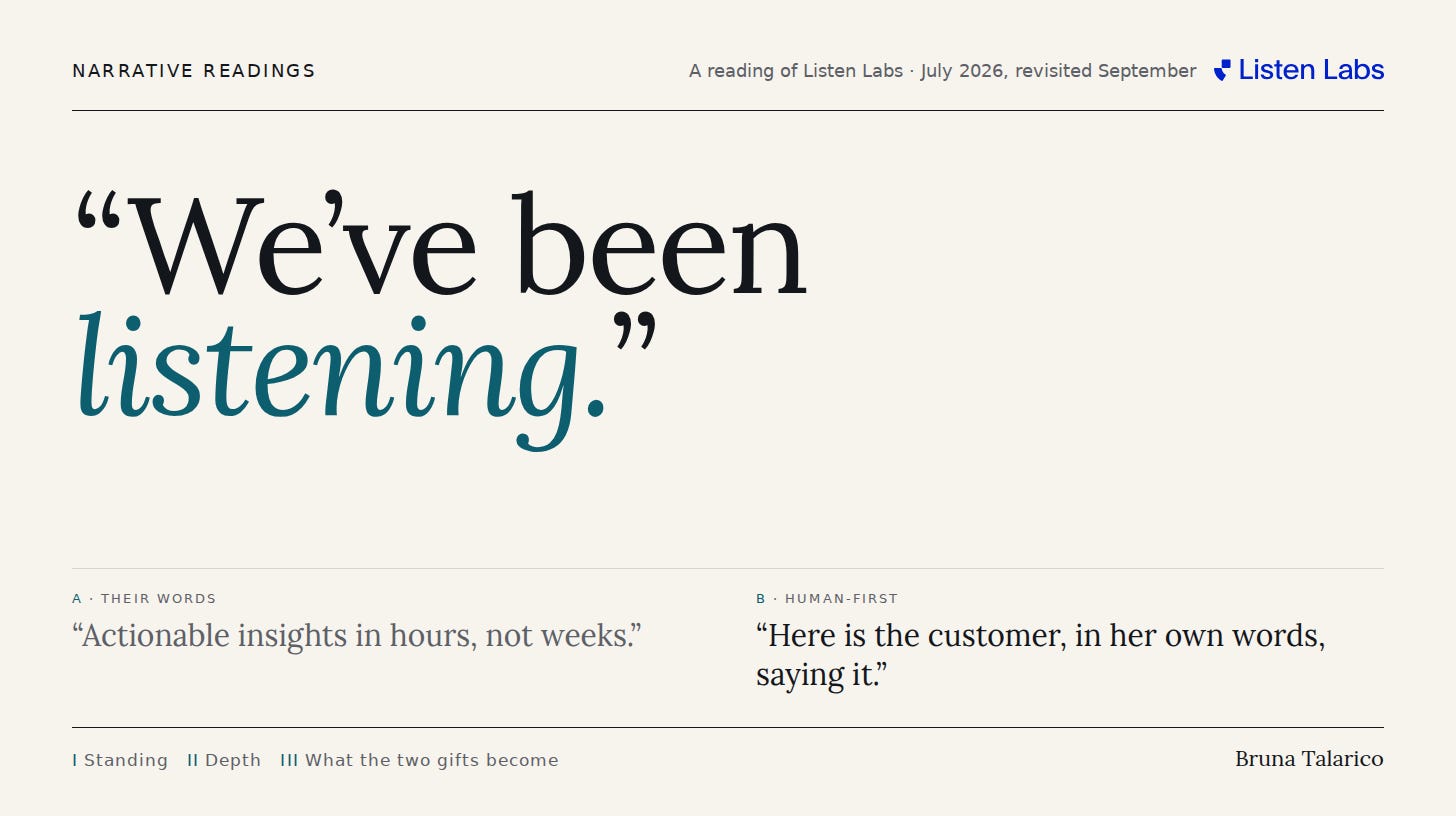
Listen gives a company two things: standing and depth. In July, the site described standing as reassurance and depth as speed. Both are ready to be told as what they are, and the founders’ letter has already written the sentence that ties them together.
When Anthropic needed to understand why developers were abandoning Claude Code during its research preview, Jane Justice Leibrock, the company's head of user experience research, ran the study on Listen. The finding was specific: people did not want to keep switching between their code editor and the terminal. Anthropic shipped a VS Code extension. Drop-off went down.1
Listen's case study frames this as speed: "100 studies for the price, at least in terms of time, of five or six," in Leibrock's words.2 The more interesting fact is the other one. A company that trains some of the world's most capable models trusted an outside AI research product enough to make a product decision based on it. That trust is what Listen gives, and speed is one of the mechanisms.
A note on timing. On September 9, TechCrunch reported that Listen walked away from a signed $125 million Series C term sheet to pursue acquisition talks with Salesforce at roughly $2 billion.3 The talks are ongoing, and nothing below depends on how they end. If anything, they sharpen the question the reading asks: what does a buyer understand Listen to be?
Two gifts
When Listen works, it gives a company two things. The first is standing: every insight traces back to the words a customer said; every AI summary can be checked against the quotes beneath it; every finding can be traced back to its source. What comes out is evidence a research-serious company can defend. The second is depth: every interview is a conversation, with follow-ups, and the words stay usable afterward.
Listen's own positioning is two-part: technology at scale plus research expertise, and the homepage, rebuilt since July, now has a section called "Research experts, on your team."4 Standing and depth are those two parts seen from the buyer's side. In July, the first was on the site as reassurance, and the second was on the site as speed.
Standing, ready to lead
The homepage now says "Every claim traces back to a real interview."5 It sits where reassurance belongs, next to the stats about respondents and languages. Standing is bigger than reassurance. It answers the one question that matters in the room where research meets money: how sure are we? It is the difference between "the AI said so" and "here is the customer, in her words, saying it." Click a claim in a report and see the moment in the interview it came from. Click a pattern in the archive and see the participants who form it.
That is a categorical break from the version of "AI-generated" that means "possibly hallucinated," and it is the version of AI research a company can ship from. Listen's own August essay on what AI owes researchers names three demands: real people, follow-up probing, verifiable work.6 The opportunity is to lead with standing, because it is why AI research is credible at all, and because a competitor without built-in traceability can't follow.
Depth, told as what it is
The case-study taglines carry the depth story in units of time. "100 Studies in the Time of 5." "10x Faster Results." "10x Faster Insight Discovery."7 All true. Depth is the thing underneath them.
Listen’s words “100 Studies in the Time of 5.” “10x Faster Results.”
Human-first approach “Our customers have the answers, and listening to them is really the key to unlocking the next phases of growth and innovation for the company.” (Jonathan Neman, Sweetgreen)
Depth is what happens inside the interview. Listen's moderator asks the question, hears the answer, and probes. It catches the say-do gap on a shared screen: you said you filter for price, but your screen shows you filtering for color. The homepage now has a whole section built on that gap, with a 42-point difference between what participants said they would pay for and what they chose.8 A survey tool is structured. A research platform schedules a human interviewer and tidies the transcript afterward. Listen runs a moderator that keeps the depth only a human used to reach, at a scale a human cannot.
The consequence is qualitative research at quantitative reach: a hundred conversations rather than a hundred survey responses. Sweetgreen's CEO, Jonathan Neman, put it in one sentence in Listen's own case study: "Our customers have the answers, and listening to them is really the key to unlocking the next phases of growth and innovation for the company."9 That is the depth story prioritized, with customers being heard with enough specificity that the next decision has somewhere to go.
Until July, that line was on the homepage; it has since been replaced with a quote from Neman about doing ten times more research for the same budget.10 The reversal speaks to the CFO, while the old one told the CEO what the company was buying. The swap turned depth into speed, in one edit.
What the two gifts become
Standing and depth compound. Without standing, an archive of AI-moderated interviews is a folder of summaries. Without depth, it is a database of survey responses. With both, it is institutional customer memory a company can build a decision on months and years later.
Listen has named this. The founders' letter for the Series B says: "Over time, Listen becomes a living archive of what your customers think and feel."11 The idea has begun to reach the product: the homepage's "Compound your learnings" pillar is the archive in feature language,12 and Pulse, the always-on conversational tracker launched in August, is the archive as a product, "a moving picture of what your customers think and why."13 The framing exists, and the product now proves it. What is left is to put the sentence at homepage weight, where the two gifts meet.
The window
The AI-research category is compressing, and this summer it took a specific turn. Simile raised $200 million at a $2 billion valuation on July 30, five months after its Series A, and defined the frontier as simulated persona modeling.14 The competitor set named in the Salesforce coverage (Simile, Outset, Keplar, Aaru) is mostly building in that direction.15 Listen sits at a different frontier: real people, deeply interviewed, whose words can be interrogated back to source and re-interviewed rather than extrapolated. Listen is hiring a founding research scientist in "human simulation,"16 so it will have a twin story of its own. The sentence that separates "grounded in real people" from "generated by a model" is worth more before that launch than after it.
Whatever Listen becomes, a Salesforce product line or an independent company at a new valuation, the story it will need most is the one the founders' letter already wrote. The homepage is ready for it.
About this series
Narrative Readings take an AI-native company at its word, on its own surfaces, and ask whether the story does the work the product needs. I call this framework Storytelling for Adoption: people only adopt what they understand, and companies only adopt what they trust. This summer I walked the diagnosis and the recommendations through with each company. The recommendations stay with them. What is published is the diagnosis, with sources in the footnotes, and what the company did next.
I'm Bruna Talarico. I built the content strategy function at Amazon Music's Global Content Organization and the go-to-market narrative for Audible's B2B unit. If you're building narrative for an AI-native product, brunatalarico.com is where to find me.
Companion readings
Listen Labs, "Anthropic" case study, listenlabs.ai/case-studies/anthropic.
Listen Labs, "Anthropic" case study, listenlabs.ai/case-studies/anthropic.
TechCrunch, "AI research startup Listen Labs scrubbed a $1.5B funding round for Salesforce talks," September 9, 2026.
Listen Labs homepage, listenlabs.ai (accessed September 15, 2026).
Listen Labs homepage, listenlabs.ai (accessed September 15, 2026).
Listen Labs, "Trust, evidence, and time: what AI owes researchers," August 15, 2026, listenlabs.ai/blog/trust-evidence-and-time-what-ai-owes-researchers.
Listen Labs, Case studies index, listenlabs.ai/case-studies (Anthropic, Emeritus, Monitas taglines).
Listen Labs homepage, listenlabs.ai (accessed September 15, 2026).
Listen Labs, "Sweetgreen" case study, listenlabs.ai/case-studies/sweetgreen.
Listen Labs homepage, listenlabs.ai (accessed September 15, 2026).
Listen Labs, Founders' letter (Series B), listenlabs.ai/founders-letter.
Listen Labs homepage, listenlabs.ai (accessed September 15, 2026).
Listen Labs, "Introducing Pulse, the conversational tracker," August 11, 2026, listenlabs.ai/blog/introducing-pulse-the-conversational-tracker.
TechCrunch, "Synthetic user startup Simile raises $200M at $2B valuation, 5 months after $100M Series A," July 30, 2026.
TechCrunch, "AI research startup Listen Labs scrubbed a $1.5B funding round for Salesforce talks," September 9, 2026.
Listen Labs, Careers, listenlabs.ai/careers ("Founding Research Scientist, Human Simulation").